Solution to Computer Systems: A Programmer's Perspective
Chapter 1
\[\begin{align}S = \frac{1}{(1-\alpha)+\alpha/k} && \text{(Amdahl’s Law)} \end{align}\]
Practice Problem 1.1
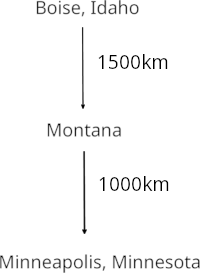
A. It takes 25 hours to travel from Boise to Minneapolis and travelling through Montana takes 20 hours. Thus \(\alpha = \frac{\text{20hr}}{\text{25hr}} = 0.6\). The average speed improved from \(\text{100km/hr}\) to \(\text{150km/hr}\). Thus, \(k=\frac{\text{150km/hr}}{\text{100km/hr}}=1.5\). By Amdahl’s law, \(S=\frac{1}{(1-0.6 + 0.6/1.5)}=1.25\).
B. If we rearrange Amdhal’s law for \(k\), we get \[k=\frac{\alpha S}{1+S(\alpha-1)}\]
Let \(v\) represent the speed at which the vehicle travels through Montana. Then, \[\alpha = \frac{\text{1500km}/v + (\text{1000km}/ \text{100km/hr})}{\text{25hr}} \]. Given \(S = 1.67\), we have \[\frac{v}{100} = \frac{1.67(\frac{\text{10hr}\cdot v + \text{1500km}}{\text{25hr}\cdot v})} {1 + 1.67(\frac{\text{(10hr)}\cdot v + 1500km}{\text{25hr}\cdot v}-1)}\]. Thus, \(v=\text{305.56km/hr}\)
Practice Problem 1.2
Given \(\alpha=0.9\) and \(S=4\), we have to improve 90% of this machine by a factor of \(k=\frac{(0.9)(0.4)}{1+4\cdot (0.9-1)} = 6\)
Chapter 2
Practice Problem 2.1
A. \( (\text{0010 0101 1011 1001 1101 0010})_{2} \)
B. \( (\text{AE49})_{16}\)
C. \( (\text{1010 1000 1011 0011 1101})_2 \)
D. \( (\text{322D96})_{16} \)
Practice Problem 2.2
| \(n\) | \(2^n\)(decimal) | \(2^n\)(hexadecimal) |
|---|---|---|
| 5 | 32 | 0x20 |
| 23 | 8388608 | 0x800000 |
| 15 | 32768 | 0x8000 |
| 13 | 8192 | 0x2000 |
| 12 | 4096 | 0x1000 |
| 6 | 64 | 0x40 |
| 8 | 256 | 0x100 |
Practice Problem 2.3
| Decimal | Binary | Hexadecimal |
|---|---|---|
| 0 | 0000 0000 | 0x00 |
| 158 | 1001 1110 | 0x9E |
| 76 | 0100 1100 | 0x4C |
| 145 | 1001 0001 | 0x91 |
| 174 | 1010 1110 | 0xAE |
| 60 | 0011 1100 | 0x3C |
| 241 | 1111 0001 | 0xF1 |
Practice Problem 2.4
A. 0x6061
B. 0x603C
C. 0x607c
D. 0x9c
Practice Problem 2.5
A. Little endian: 0x78 Big endian: 0x12 B. Little endian: 0x7856 Big endian: 0x1234 C. Little endian: 0x785634 Big endian: 0x123456
Practice Problem 2.6
A. \(\begin{align} \text{0x0027C8F8 = 0000 0000 0010 0111 1100 1000 1111 1000} \\ \text{0x4A1F23E0 = 0100 1010 0001 1111 0010 0011 1110 0000}\end{align}\)
B.
\(\begin{align}\text{0x0027c8f8 = 0000 0000 0010} \textbf{ 0111 1100 1000 1111 1000} \\ \text{0x4A1F23E0} \gg \text{2 = 0001 0010 1000} \textbf{ 0111 1100 1000 1111 1000} && \text{(20 bits)}\end{align}\)
C. See 2.6 B
Practice Problem 2.7
\(\text{0x7271706F6E6D}\)
Practice Problem 2.8
| Operation | Result |
|---|---|
| \(a\) | \([01001110]\) |
| \(b\) | \([11100001]\) |
| \(\sim a\) | \([10010110]\) |
| \(\sim b\) | \([10101010]\) |
| \(a\& b\) | \([01000001]\) |
| \(a | b \) | \([01111101]\) |
| \(a^\widehat{} b\) | \([00111100]\) |
Practice Problem 2.9
A.
| Colour | Complement |
|---|---|
| Black | \(111\) |
| Blue | \(110\) |
| Green | \(101\) |
| Cyan | \(100\) |
| Red | \(011\) |
| Magenta | \(010\) |
| Yellow | \(001\) |
| White | \(000\) |
B.
\(\begin{align} \text{Blue} | \text{Green} &= \text{Cyan} \\ \text{Yellow} \& \text{Cyan} &= \text{Blue} \\ \text{Red}^\widehat{} \text{Magenta} &= \text{Blue} \end{align} \)
Practice Problem 2.10
| Step | *x | * y |
|---|---|---|
| Initially | a | b |
| Step 1 | a | a^b |
| Step 2 | a^a^b = b | a^b |
| Step 3 | b | b^a^b = a |
Practice Problem 2.11
A. \(\lceil{\frac{2k+1}{2}}\rceil\)
B. a[first] and a[last] point to the same variable in the last iteration when cnt is odd. The function inplace_swap xor these two variables however since they point to the same number, the operation evaluates to zero.
C.
    for (first = 0, last=cnt-1;
        first < last;
        first++, last--)
Practice Problem 2.12
A. x &= 0xFF
B. x ^= ~0xFF
C. x |= 0xFF
Practice Problem 2.13
/* Declarations of functions implementing operations bis and bic */
int bis(int x, int m);
int bic(int x, int m);
/* Compute x|y using only calls to functions bis and bic */
int bool_or(int x, int y) {
    int result = bis(x, y);
    return result;
}
/* Compute x^y using only calls to functions bis and bic */
int bool_xor(int x, int y) {
    int result = /* left to reader to solve (I couldn't do it myself) */;
    return result;
}
Practice Problem 2.14
\(\begin{align} a &= 0101\ 0101 = 0x55\\ b &= 0100\ 0110 = 0x46\end{align}\)
| Expression | Value | Expression | Value | |||
|---|---|---|---|---|---|---|
| a & b | 68 | a&&b | 0x01 | |||
| a | b | 87 | a | b | 0x01 | |
| ~a | ~b | -71 | !a | !b | 0x00 | |
| a & !b | -71 | a&&~b | 0x01 |
Skipped to Problem 2.45 due to lack of interest and knowing most of the content.
Practice Problem 2.45
| Fractional value | Binary representation | Decimal representation |
|---|---|---|
| \(\frac{1}{8}\) | 0.001 | 0.125 |
| \(\frac{3}{4}\) | 0.11 | 0.75 |
| \(\frac{5}{16}\) | 0.0011 | 0.3125 |
| … | … | … |
You get the point
Practice Problem 2.46
A.
\(\begin{align}0.1 &= 0.0001\ 1001\ 1001\ 1001\ 1001\ 1001\ [1001]\\x &= 0.0001\ 1001\ 1001\ 1001\ 1001\ 0100\\0.1-x &= 0.0000\ 0000\ 0000\ 0000\ 0000\ 0101\ [1001]\end{align}\)
B. \(\begin{align} 0.1-x &= 2^{-22} + 2^{-24} + [(2^{-25} + 2^{-28}) + (2^{-29} + 2^{-32}) + …] \\ &= 2^{-22} + 2^{-24} + \sum_{i=0}^{\infty} (2^{-25-4i} + 2^{-28-4i})\\ &= 2^{-22} + 2^{-24} + \frac{1}{5} \cdot 2^{-32} & \text{Simplify the sum and apply geometric series formula}\\ &= 2^{-22}(1+2^{-2}+\frac{2^{-10}}{5})\\ &= 2^{-22}(\frac{6401}{5120}) \\ &= 2.9806979\cdot 10^{-7}\end{align}\)
C.
\(\text{100hr} = 3600000 \cdot \text{0.1s} = 3600000\cdot (0.000110011[0011]\cdots)_2\\ \) \(3600000\cdot 0.1\text{s} - 3600000\cdot (x)\text{s} = 3600000(0.1\text{s}-(x)s)=3600000\cdot 2.9806979\cdot 10^{-7}\text{s} = 1.073051244\text{s}\)
D.